


Gummies are perhaps the most ubiquitous form of THC-infused edible on the market today. Cannabis data intelligence firm Headset.io put the gummy market size in 2021 at $976M, followed by (a large margin) chocolates at $150M, soft chewables at $131M, lozenges/gum at $36M, mints at $33M, and then the humble cookie at $28M.
So how is one to differentiate themselves in the hyper-competitive gummy space?
In my opinion, as an Oregon market recreational consumer who has easily spent thousands on edibles over the years, across multiple states, I’d say there are three primary ways cannabis brands are successfully differentiating themselves today, detailed below.
1. Competing On Branding & Marketing
This is probably the most popular avenue, as the cannabis industry is not short on artistic individuals. As such, the industry pumps out some of the dopest (literally and figuratively) branding around, and that much is undeniable.
Likewise, marketing, whether it be via iNflUeNceR partnerships, buying billboards, or just paying for premium display space at top-tier dispensaries, the marketing and premium brand positioning seems to be the current go-to-market share growth strategy.
2. Competing On Value & Cost
In contrast to the premium brand positioning and dumping all available investment dollars into marketing campaigns, gummy brands’ second most popular growth strategy seems to be investing heavily in scale to outcompete the competition in value-oriented pricing.
Some big dogs can’t be touched, but that’s fine. In apparel, high-end designer luxury and value-oriented Carhartt can both make fortunes for people willing to do the work.
Value operators are looking to sell to the Carhartt-wearing demographic that buys their bud in the strip mall joint and are highly price-sensitive. Shopping thrifty isn’t meant to be condescending because I fall into this category myself.
Ask any budtender what kind of questions they get about gummies. After “what’s strongest,” the next question is usually around price and value.
The speed of math skills budtenders display is impressive as they break down the package’s total THC in milligrams divided by the pre-portioned pieces inside. If you’re lucky, the approximate per-serving cost for each brand on display at any given moment. It’s straight-up Rainman shit.
The fact that budtenders all seem to have this memorized proves that there are many shoppers simply looking for a good deal, and the market seems to confirm that cavalier socio-economic assumption.
3. Competing On Quality
In my opinion, this is probably the space with the most opportunity, as few players currently invest their resources entirely into making the best damn edible product possible, especially in the edibles space.
Think high-end. Think exotics. Think top-shelf diamond-tier Emerald Cup award winner.
If you can deliver the goods, you can make extremely large profits in this category, like Gucci, Louis Vuitton, and McClaren do in their respective markets.
This is also an old-school form of capitalism, providing something of value that people will prize accordingly. We see this success in the popularity of organic, living soil and craft-cultivated exotic strains in the flower market.
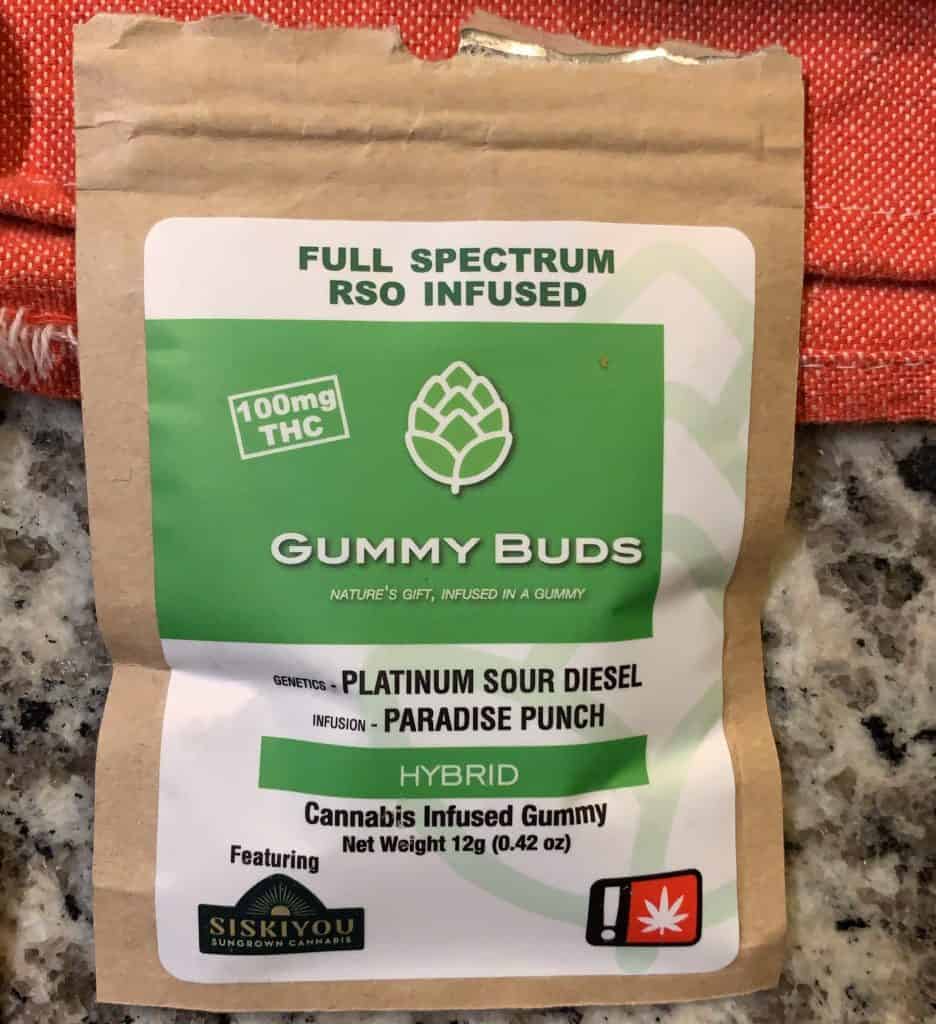
Well, the same craft cannabis mentality can be applied to edibles as well; they don’t always have to be about the packaging or the value. Oregon’s Gummy Buds is one such company channeling this 3rd option and competing heavily in quality.
What Makes a Craft Gummy?
Many gummy companies often exclude the strain/cultivator from which the THC was derived because they don’t know.
Cheap gummies are often made with THC distillate, which is the most affordable form of THC you can get because the extraction method strips pretty much everything from the cannabis plant except the THC or CBD, depending on the extractor’s goals.
Distillate extraction involves using carbon dioxide, butane, or ethanol to strip the plant of much of its innate goodness. This process results in an incredibly high THC percentage, often 98% THC. The process is efficient and cheap at scale, which is why so many canna-kitchens use it.
Anyone who has vaped distillate will know what this high THC concentration, minus the accompanying terpene entourage, feels like: fast and intense, if not a bit hollow.
The only time I’ve ever struggled after getting high was ripping a distillate pen at Cirque du Soleil in Vegas and then blacking out in the hallways trying to get out. It was not pleasant.
Rick Simpson Oil (RSO), on the other hand, is the exact opposite type of extraction as it is a “whole plant extract,” meaning instead of purposely trying to strip everything out of the plant minus THC, it’s the opposite, RSO aims to maintain as many of the plant’s natural cannabinoids, terpenes, and flavonoids as possible.
RSO also uses a solvent, usually grain alcohol, to extract the cannabinoids gently from the plant. For example, the key difference between distillate extractions and RSO is that RSO does not use heat or high pressure.
The gentler extraction means the total THC percentage for an RSO will largely depend on the strain used for the extraction, usually maxing out at 60-80% THC compared to distillates at 98%.
Making RSO is slightly less industrial than distillate, especially if using single-strain original plant matter vs. buying large quantities of mixed strains for distillate extraction.
So, a craft gummy will feature a single strain origin, preferably clearly stated on the package, and an RSO extract full of beneficial cannabinoids, terpenoids, and flavonoids, resulting in a truly full-spectrum experience.
Gummy Buds does this with their RSO-infused, strain-specific, full-spectrum, potent little gummies.
Understated Bag Appeal, Big Impact
Gummy Buds are packaged relatively conservatively. Of the three marketing strategies (marketing, budget, quality), it’s pretty clear they’re going for a minimalist quality vibe, with the gummies being packaged in humble brown little bags with minimal branding.
I got my Gummy Buds from the fine folks at Oasis Cannabis in Seaside in preparation for a magical nighttime beachside fire. If the guys behind the counter had not personally recommended Gummy Buds, I might have completely overlooked them, and for that, if ya’ll are reading this, thank you!
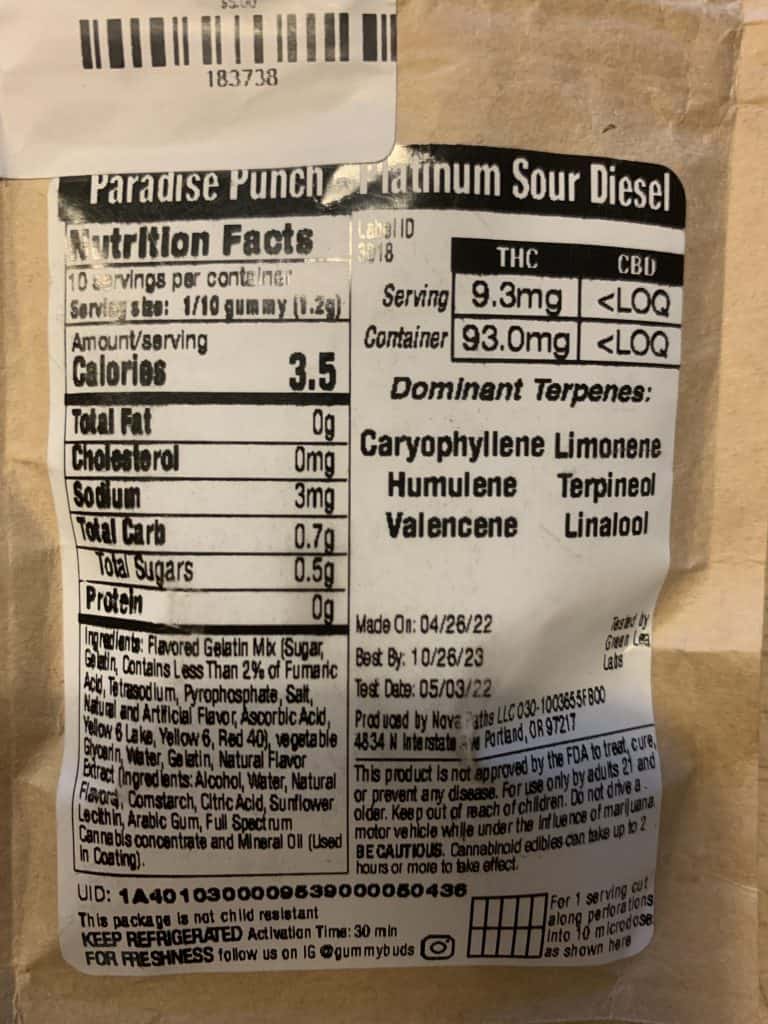
The gummies themselves come in one piece. Compared to many other value operators, you may mistakenly think it’s a single serving and pop the thing in one go. ..and I’m sure people do. At 93mg of THC, that would be one hell of a ride. Too rich for my blood, old sport!
This would be potentially the only “con” to this product, that is, packing so much godamn goodness into such a tiny ass form. Many consumers will be used to very obviously pre-portioned 10mg/gummy products in a 50mg box/bag.
Thankfully, Oasis gave us a heads-up, noting that the RSO flavor can be a bit intense but that the effect was well worth it.
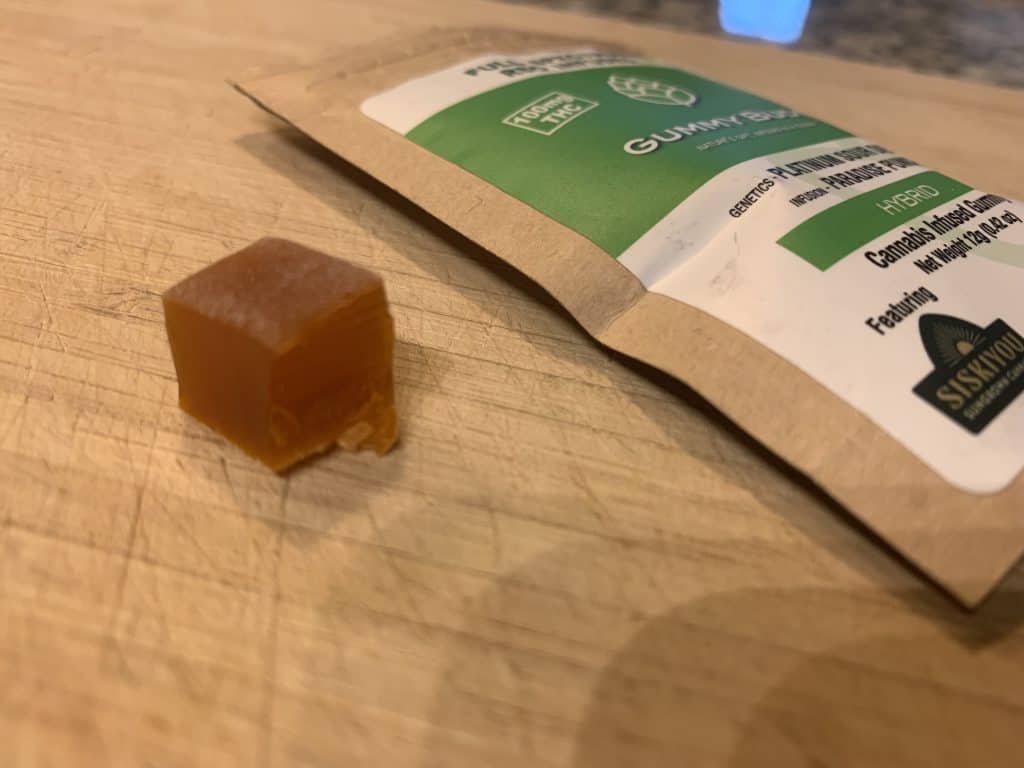
I snagged the green bag, a hybrid option featuring Platinum Sour Diesel genetics grown by the one and only Siskiyou Sungrown Cannabis for the extraction.
Siskiyou is well known in Oregon for its organic, whole-plant, full-spectrum, native soil, organic solvents (organic cane alcohol), RSO tinctures, and cannabis extracts.
Starting with holistic top-shelf buds is key to producing a top-shelf RSO, which, if you’re making gummies, is key to making a truly impactful little chewable, which Gummy Buds executes perfectly.
If you’re not into full-body space journeys, they also make Gummy Buds, which are CBD gummies. They feature East Fork Cultivars CBD, which, if you haven’t heard, is pretty much at the top of the game when it comes to cultivating unique CBD-dominant strains with amazing terpene profiles.
Why RSO Craft Gummies Are Worth It
When it comes to anything processed, from vape cartridges to gummies to tinctures and everything in between, it’s always better to get the least-processed, ideally full-spectrum product possible.
Full-spectrum products are better because the cannabis plant isn’t just a THC factory; it produces 100+ different cannabinoids and 200+ terpenoids, which will vary in quantity and ratio depending on the genetics and growing environment of the plant. If you multiply all of these inputs, you get infinitely more combinations than dealing with THC in isolation.
As such, this aptly named “entourage effect” of all cannabis plant compounds will produce an equally textured high experience.
I feel Gummy Buds not just in my sensory processing but in the direction of my cognitive experience and body. This aligns well with my experience with full-spectrum Magic Number Mega Drops.
There were times, like my first Gummy Buds experience, lying against a smooth, white, weather-beaten log that had washed up on the beach, next to a crackling little fire, as invigorating ocean mist descended upon me, where it almost felt like waves of well-being were pulsing through my entire body.

Similarly, simply lying on my living room floor after a solid Gummy Buds dose and a delicious dinner proved to be an unquestionably complete high experience compared to many other forms of edibles or even smoking flower.
But don’t take my word for it; try some RSO gummies and see for yourself!
It’s worth reiterating, though, that the Gummy Buds product is quite small, so you’ll feel like you’re consuming a very tiny amount if you try to dose out 10-20mg worth. Trust me; these little bad boys are strong, so start small with all new edibles and work your way up.
The density and amount of RSO in each gummy mean that if you are looking for a pure candy flavor, you won’t get it; the bitterness of the RSO is definitely noticeable. It wasn’t a problem because I love bitter things like grapefruit. If you don’t like bitter, you can use a beverage to down it more quickly.
What you’ll get will be an experience worth remembering, and perhaps, like me, it will make you ONLY want RSO gummies going forward!